

SETTING THE PACE WITH
AVEIR™ LEADLESS
PACEMAKERS
AVEIR™ LEADLESS
PACEMAKERS
The only leadless solutions that can provide therapy
for all common pacemaker indications1,2,3
INDICATIONS FOR USE1,10
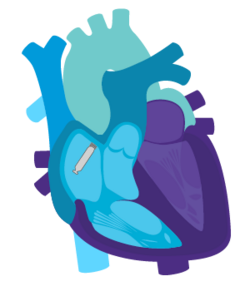
AVEIR™ VR VENTRICULAR LEADLESS PACEMAKER (LP)
- Significant bradycardia and normal sinus rhythm with only rare episodes of atrial ventricular (AV) block or sinus arrest
- Chronic atrial fibrillation
FIND OUT MORE ABOUT:
Upgradeable system1,6
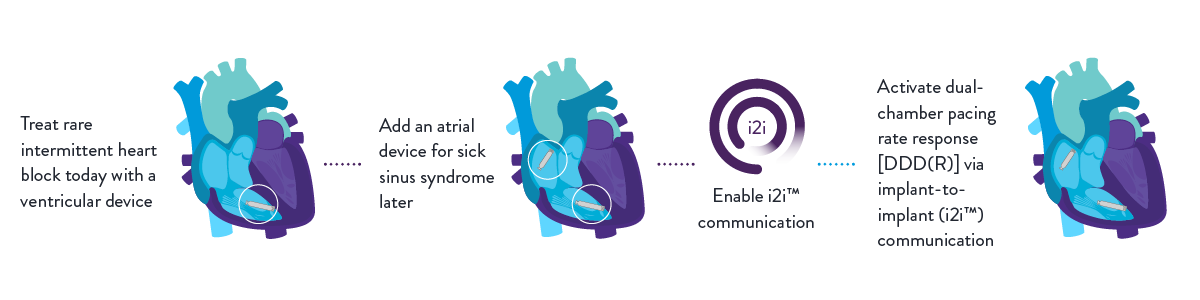
AVEIR™ VR LP in young and high-risk patients
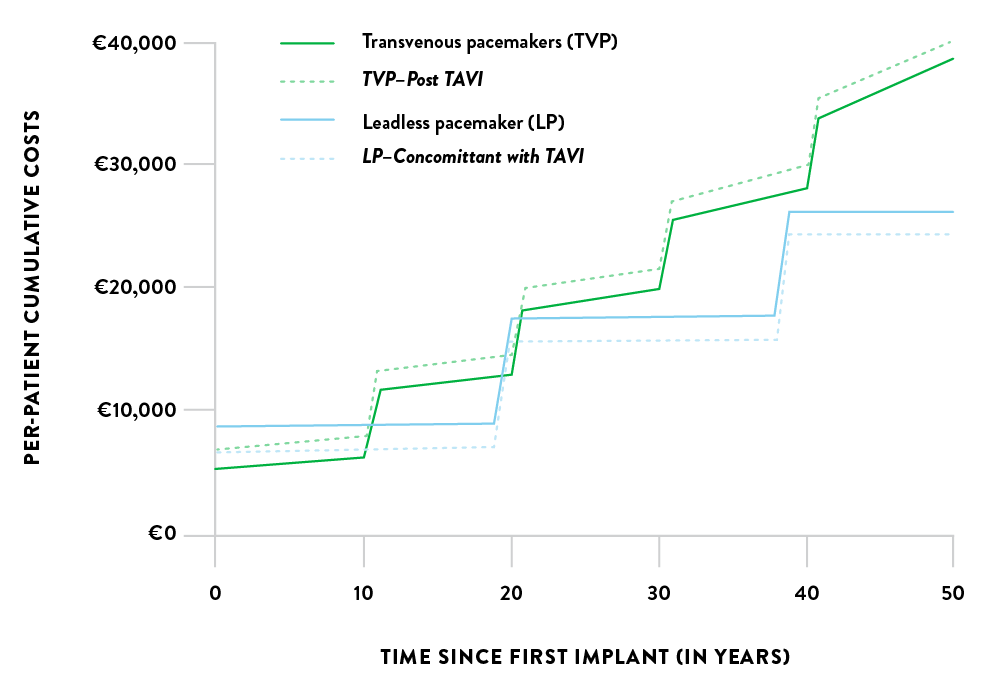
IMPLANTING AVEIR™ VR LP IN YOUNG AND HIGH-RISK PATIENTS IS MORE ECONOMICALLY BENEFICIAL LONG TERM COMPARED WITH TRANSVENOUS PACEMAKERS (TVPs).19
Individual level:
Although AVEIR™ VR LPs have higher upfront implantation costs than single‑chamber ventricular TVPs, this initial cost difference is offset over time by lower complication costs and longer battery life.
- In patients requiring >11 years of ventricular pacing, LPs are less costly than TVPs
- In patients undergoing transcatheter aortic valve implantation (TAVI) and requiring permanent ventricular pacing, implanting LP concomitantly with TAVI is less costly than implanting a post-TAVI TVP
Population level:
LP implantation has a ≥95% probability of reducing long‑term costs vs TVPs in:
- Patients aged ≤75 years (overall or tricuspid subgroup)
- Patients aged ≤80 years in high‑risk groups (excluding tricuspid and end-stage renal disease)
- All end-stage renal disease and TAVI patients
CUMULATIVE PACEMAKER-RELATED COSTS IN AVERAGE PATIENT
Connext
TV
TV
TV
Understanding AVEIR VR Retrieval

Why Leadless Pacing Summit 2026 Matters
AVEIR Atrial LP AAI Implant Training Supplement
AVEIR DR Virtual Implant Training Supplement
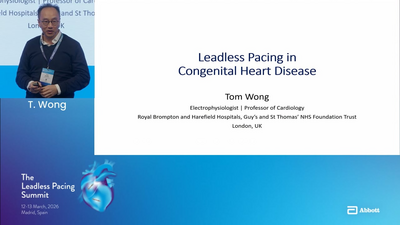
Leadless in Congenital Patients
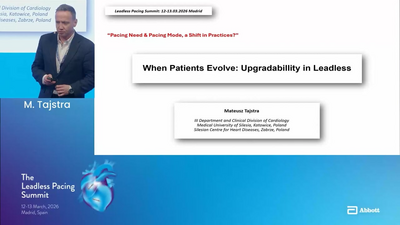
When Patients Evolve: Upgradability in Leadless
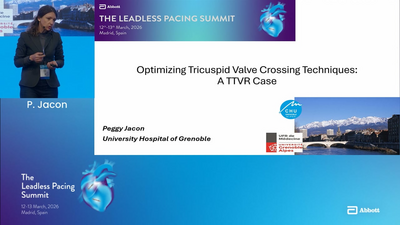
Optimizing Tricuspid Valve Crossing: Case example
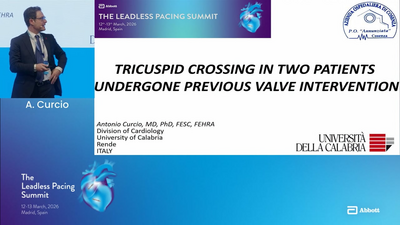
Optimizing Tricuspid Valve Crossing: Case example

Health Economics of Leadless Therapy

Learn AVEIR Leadless Pacemaker Follow-Up Checks
References
- AVEIR™ Leadless Pacemakers and Delivery Catheter IFU. ARTEN600361108.
- Micra‡ VR2 MC2VR01 IFU.
- Micra‡ AV2 MC2AVR1 IFU.
- Udo EO, Zuithoff NP, van Hemel NM, et al. Incidence and predictors of short- and long-term complications in pacemaker therapy: the FOLLOWPACE study. Heart Rhythm. 2012;9(5):728-35. doi: 10.1016/j.hrthm.2011.12.014.
- Cantillon DJ, Exner DV, Badie N, et al. Complications and Health Care Costs Associated With Transvenous Cardiac Pacemakers in a Nationwide Assessment. JACC Clin Electrophysiol. 2017;3(11):1296-1305. doi: 10.1016/j.jacep.2017.05.007.
- AVEIR Leadless Pacemakers and Delivery Catheter IFU. ARTEN600307044. ARTEN600350965.
- Cha YM, El-Chami MF, Liu CF, et al. 2026 HRS/AHA/APHRS/EHRA/IDSA/LAHRS/PACES/STS expert consensus statement update on cardiovascular implantable electronic device lead management and extraction. Heart Rhythm. 2026;S1547-5271(26)02264-2. doi: 10.1016/j.hrthm.2026.04.015.
- Boersma LV, El‑Chami M, Steinwender C, et al. Practical considerations, indications, and future perspectives for leadless and extravascular cardiac implantable electronic devices: a position paper by EHRA/HRS/LAHRS/APHRS. Europace. 2022;24(10):1691‑1708. doi:10.1093/europace/euac066.
- National Institute for Health and Care Excellence (NICE). Leadless cardiac pacemaker implantation for bradyarrhythmias. Health Technology Guidance HTG770. Feb 25, 2026. Accessed June 16, 2026. https://www.nice.org.uk/guidance/htg770.
- AVEIR Leadless Pacemakers and Delivery Catheter IFU. ARTEN600175957; ARTEN600307044; ARTEN600361109.
- Nilsson KR Jr, Birgersdotter-Green U, Saleem-Talib S, et al. Leadless atrial versus transvenous pacing for sinus node dysfunction: 1-year outcomes from the leadless ARRIVE real-world study. Europace. 2026;28(4):euag072. doi: 10.1093/europace/euag072.
- Ip JE, Brady PA, Kroman AM, et al. Leadless Versus Transvenous Single-Chamber Ventricular Pacemakers: Real-World Evidence From AVEIR™ VR Coverage With Evidence Development Study. J Am Heart Assoc. 2025;14(21):e042471. doi: 10.1161/JAHA. 125.042471.
- Lo M, Amin AK, Kowalski M, et al. Leadless Versus Transvenous Dual-Chamber Pacemakers: Real-World Evidence From AVEIR DR Coverage With Evidence Development Study. J Cardiovasc Electrophysiol. 2026;37(3):544-553. doi: 10.1111/jce.70255.
- Neuzil P, Exner DV, Knops RE, et al. Worldwide Chronic Retrieval Experience of Helix-Fixation Leadless Cardiac Pacemakers. J Am Coll Cardiol. 2025;85(11):1111-1120. doi: 10.1016/j.jacc.2024.10.094.
- Glikson M, Nielsen JC, Kronborg MB, et al. 2021 ESC Guidelines on cardiac pacing and cardiac resynchronization therapy. Eur Heart J. 2021;42(35):3427-3520. doi: 10.1093/eurheartj/ehab364. Erratum in: Eur Heart J. 2022 May 1;43(17):1651. doi: 10.1093/eurheartj/ehac075.
- Kusumoto FM, Schoenfeld MH, Barrett C, et al. 2018 ACC/AHA/HRS Guideline on the Evaluation and Management of Patients With Bradycardia and Cardiac Conduction Delay: Executive Summary: A Report of the American College of Cardiology/American Heart Association Task Force on Clinical Practice Guidelines, and the Heart Rhythm Society. J Am Coll Cardiol. 2019;74(7):932-987. doi: 10.1016/j.jacc.2018.10.043. Erratum in: J Am Coll Cardiol. 2019;74(7):1014-1016. doi: 10.1016/j.jacc.2019.06.046.
- Breeman KTN, Dijkshoorn LA, Wilde AAM, et al. Predicted Need for Atrial and Ventricular Pacing Per Indication Group in Patients With Dual-Chamber Pacemakers. Heart Lung Circ. 2023;32(5):629-637. doi: 10.1016/j.hlc.2023.02.007. Erratum in: Heart Lung Circ. 2024;33(2):e17. doi: 10.1016/j.hlc.2024.01.003.
- Ip JE, Cheung JW , Liu CF , et al. Maximizing battery longevity of leadless pacemaker systems by optimizing individualized programming. Heart Rhythm. 2026;23(2):e293-e294. doi: 10.1016/j.hrthm.2025.10.021.
- Vogt ML, Kellmann T, Ihara Z. Patient’s lifetime budget impact of a leadless pacemaker compared to transvenous pacemakers in France. Poster presented at: European Heart Rhythm Association; April 12-14, 2026; Paris.