

PACEMAKERSOPTIMIZE YOUR PATIENT THERAPY
PREMIUM FEATURES
PHYSICIAN-PREFERRED SIZE AND SHAPE1
The Assurity MRI™ pacemaker offers exceptional longevity in a small device size and a physiologic physician-preferred shape enabling a smaller incision and pocket size.

MRI-READY
Assurity MRI™ pacemaker with UltiPace™, Tendril™ STS, or IsoFlex Optim™ pacing leads now gives you 3 Tesla (T) magnetic resonance imaging (MRI) options you didn't have before — immediate access to MRI scans without compromising device performance.‡ Eliminate the six-week wait time for MRI scans that Medtronic, Boston Scientific, and Biotronik recommend.2-4 Will your patient be ready?
- Meets industry-standard MRI testing parameters
- Shortest delay between implantation and scan feasibility on the market for pacemakers.2-4
- Magnetic resonance (MR) Conditional for full body 1.5T and 3T MRI scans§


SPECIFIC FEATURES FOR OUR DUAL- AND SINGLE-CHAMBER MODELS
Dual-Chamber
State-of-the-art features
- Complete automaticity (atrial and ventricular)
- Ventricular Intrinsic Preference (VIP™) technology
- AF Suppression™ algorithm
- Programmable AT/AF alerts
- SenseAbility™ technology
Designed to deliver optimal therapy for patients at implant and throughout their lives
Longevity
- Outstanding longevity provides 9.4 years of service life,5 which is supported by an 8-year warrantyǁ
- 6-month ERI-EOL interval
Single Chamber
State-of-the-art features
- Automaticity
- Ventricular AutoCapture™ pacing system for ventricular implants
- ACap™ Confirm feature
- AF Suppression™ algorithm
- AT/AF diagnostics for atrial implants
- SenseAbility™ technology (based upon the lead chamber selected)
Designed to deliver optimal therapy for patients at implant and throughout their lives
Longevity
- Outstanding longevity provides 13.9 years of service life,¶ which is supported by a 10-year warranty‖
- 6-month ERI-EOL interval
LEARN MORE:
The Ventricular Intrinsic Preference (VIP™) algorithm promotes intrinsic ventricular conduction by lengthening the sensed/paced atrioventricular interval. This can be triggered by search or automatically upon detection of an intrinsic event.
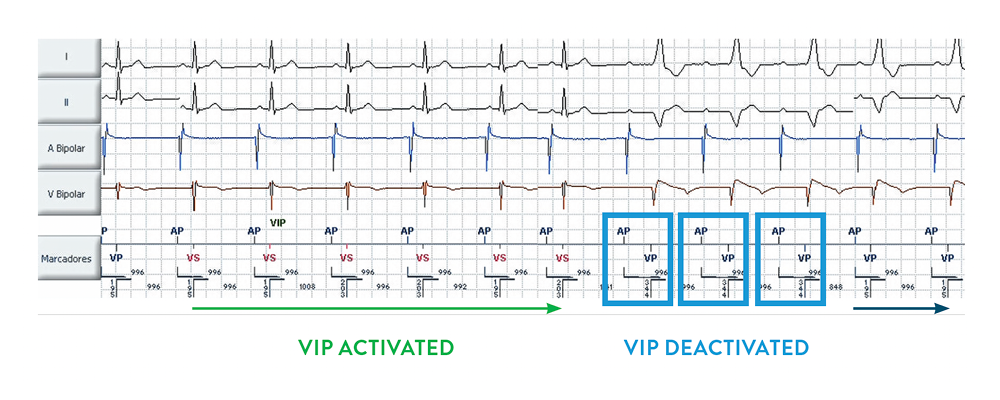

WHAT CAN VIP™ TECHNOLOGY OFFER YOUR PATIENTS?
- Reduces the chances of right ventricle (RV) remodelling associated with increased RV pacing
- Extends device longevity by reducing ventricular pacing (VP)
ACTIVATION
- When 1 intrinsic R-wave is detected during a search interval
- When 3 consecutive R-waves are detected outside a search interval
DEACTIVATION
- When intrinsic conduction is interrupted due to patient blockage
- Active up to 110 bpm to allow fast pace tracking

WHAT CAN VIP™ TECHNOLOGY OFFER YOUR CLINIC?
- Easy to programme
- Reduction in number of patients attending clinics due to symptoms associated with RV pacing or battery monitoring
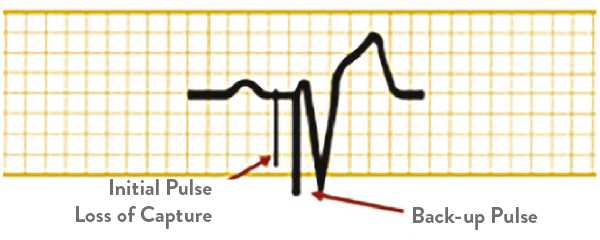
Offer your patients the maximum in threshold adaptability and safety with ventricular Beat-By-Beat™ capture confirmation. The AutoCapture™ pacing system automatically delivers a 5.0V backup safety pulse when noncapture is detected, and it may be programmed to either a bipolar or unipolar configuration.
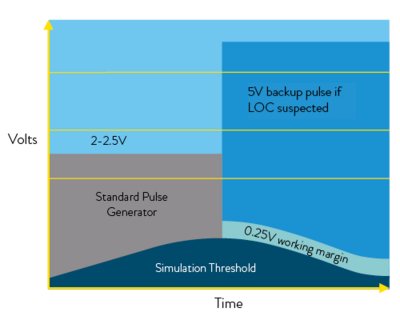
LOC, loss of capture.
HOW IT WORKS

WHAT CAN AUTOCAPTURE™ OFFER YOUR PATIENTS
SAFETY:
- Reduces symptoms associated with potential LOC
- Prolongs battery longevity resulting in less generator replacements for patients
EVOKED RESPONSE = CAPTURE
Capture is verified by detecting an electrical signal, known as an evoked response, from the lead/tissue interface. If an evoked response is not detected, a 5V backup pulse is delivered 100 ms after initial pulse.

WHAT CAN AUTOCAPTURE™ OFFER YOUR CLINIC
- Fast programming and available from implant
- Faster follow-up times as trend data available from last device clear
- Threshold trends available on Merlin.Net™ Patient Care Network (PCN)
- Automatically runs atrial threshold tests and can adjust amplitudes accordingly.
- Provides adjusted right atrial (RA) amplitudes in relation to the threshold and provides trend data for assessment of the RA threshold status over time.
- By monitoring threshold and adjusting outputs, it maximises the chances of maintaining atrioventricular (AV) synchrony, if atrial pacing is required.
- Threshold trend data is provided and can be monitored via the Abbott Cardiac Rhythm Management (CRM) programmer of Merlin.Net™ Patient Care Network (PCN).
- Available in all dual-chamber Abbott cardiac implantable devices
| Measured Threshold | Voltage Added for output |
|---|---|
| 0.124 - 1.5V | 1V |
| 1.625 - 2.25V | 1.5V |
| 2.375 - 3V | 2.5V |
| >3V | High output 5V |
HOW IT WORKS
ACap™ Confirm uses a non-capture template to assess for capture.
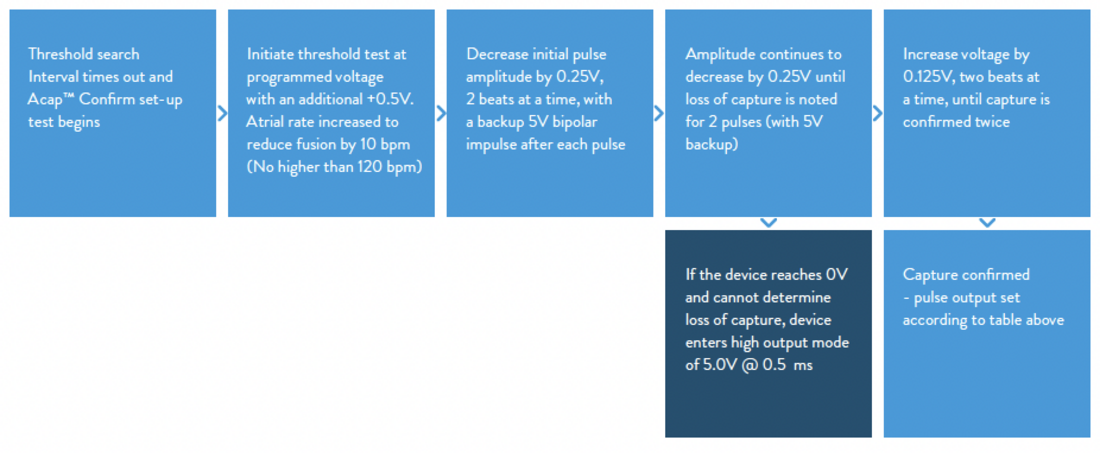
HOW IT WORKS
ACap™ Confirm uses a non-capture template to assess for capture.
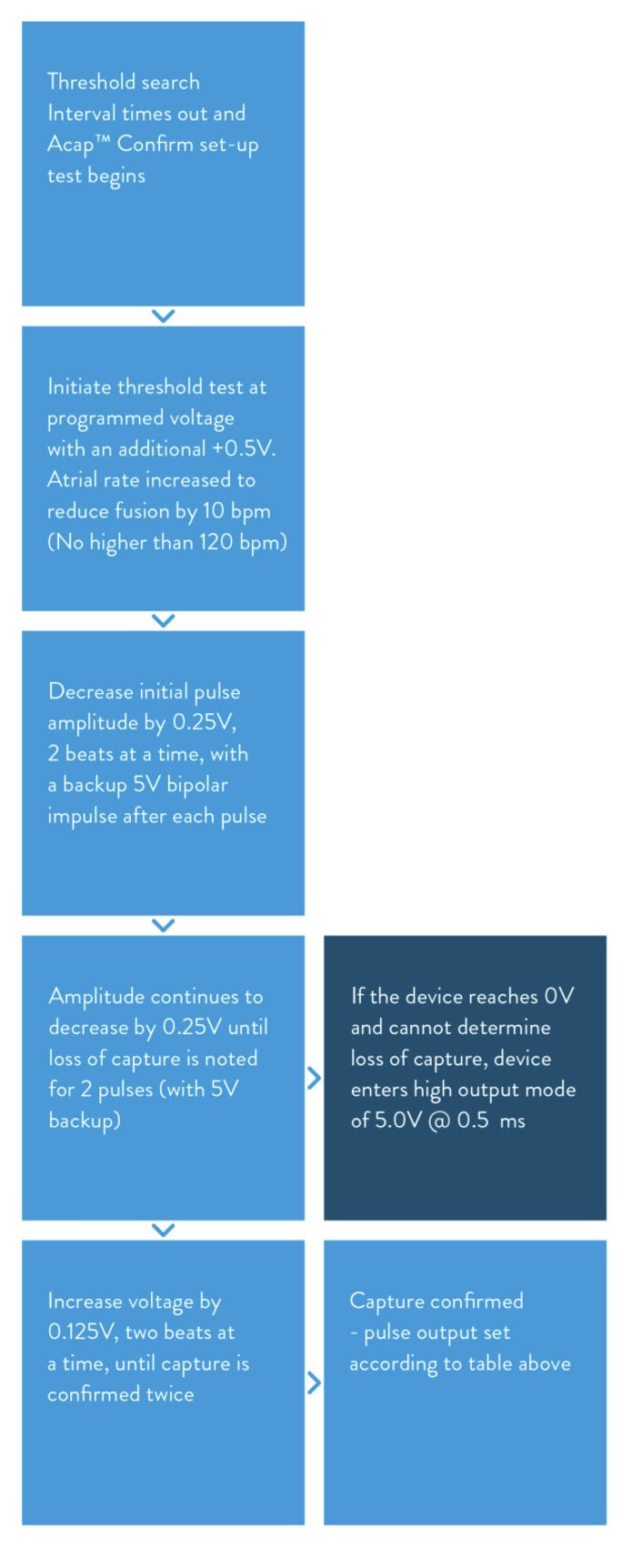
Threshold search – How ACap™ Confirm threshold search is conducted once reaching search interval (8/24 hours).
WHAT CAN AUTOCAPTURE™ OFFER YOUR PATIENTS
- Reduces symptoms associated with potential loss of AV synchrony
- Potentially prolongs battery longevity resulting in longer durations between surgical interventions
WHAT CAN AUTOCAPTURE™ OFFER YOUR CLINIC
- Simple programming
- Faster follow-up times as trend data available from last device clear
- Merlin.Net™ PCN monitoring

Reduces symptomatic atrial fibrillation (AF) episodes.
- AF is one of the most difficult arrhythmias to treat
- Associated with increased risk of stroke in those with pacemakers
Successfully tested solution for difficult to treat AF.6
- Successfully tested Overdrive Pacing Algorithm
- Demonstrated reduction in AF burden

The only pacemaker with programmable AT/AF alerts specifically indicated for detecting atrial tachyarrhythmias, which have been found to be associated with an increased risk of stroke in elderly, hypertensive, pacemaker patients without prior history of AF.7
Data-driven diagnostics for accurate treatment planning.6

Designed to automatically adjust device sensitivity to cardiac signals.
- Continuous signal measuring
- Trending graphs of P- & R-waves
- Automatic programming of sensibility
- Optimal detection of AT/AF episodes
Simplifies optimal detection of cardiac signals.6

Real-time electrogram (EGM) waveform, as well as the associated event markers that precede and follow a specific triggering event, can be programmed to automatically record up to 14 minutes of stored EGMs when encountering one or more programmable trigger options.

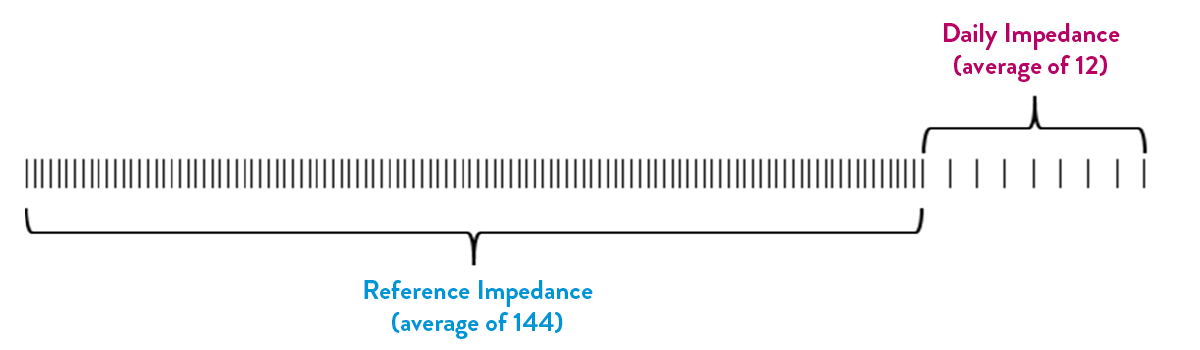
A fall in thoracic impedance, which is sustained over a period of time, may indicate a higher probability of thoracic congestion, which could be clinically relevant to the patient's condition.
How does CorVue™ measure the transthoracic impedance?
The device sends out a sub-pacing threshold output during the physiologic refractory period of the heart between a pair of electrodes and simultaneously measures the voltage change across the pair of electrodes.
The transthoracic impedance is measured every 2 hours which builds and updates both the reference and daily impedance graphs. If the daily impedance falls below the reference impedance for a pre-defined number of days, an alert can be triggered via the programmer and Merlin.net™ Patient Care Network (PCN).
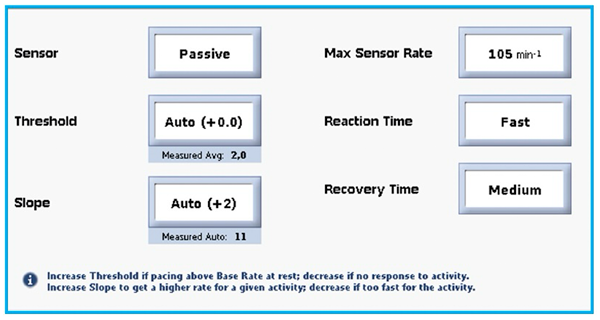
Accelerometer sensor-driven rate-modulated pacing in Abbott’s single and dual chamber devices (including permanent pacemakers, implantable cardioverter defibrillators and cardiac resynchronization therapy devices).
Enables sensor-driven pacing for your chronotropic incompetent patients in order to support their metabolic needs. Rate-responsive pacing will allow sensor-driven pacing between the base rate and the maximum sensor rate.
PROGRAMMABILITY
Programming options of ON, OFF or PASSIVE. PASSIVE will provide diagnostic sensor information but will have no impact on the pacing rate.
The programmable parameters of Abbott’s. RATE RESPONSIVE PACING allow a dynamic and adaptable pacing in response to the patients’ activity.
PROGRAMMABLE SETTINGS
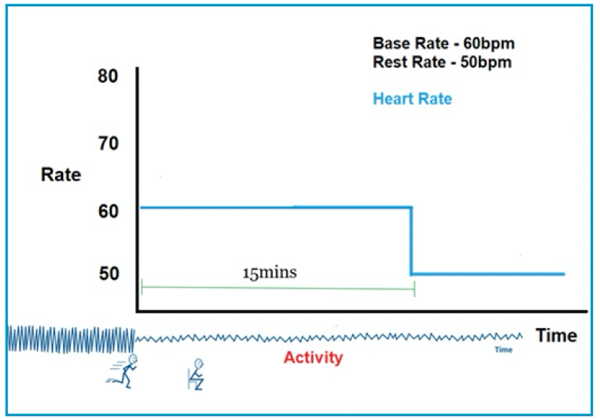
Mimic physiological resting-rate behaviour during inactivity. Device longevity is lengthened by promoting intrinsic or reducing the pacing rate during rest.
SENSOR-DRIVEN TECHNOLOGY
As a sensor-driven algorithm (opposed to clock-based), REST RATE provides a physiological reduction in pacing rate during periods of patient inactivity. Harnessing the device’s accelerometer, the algorithm is completely independent to time and will activate Rest Rate whenever it detects the patient has been inactive for a period of over 15 minutes. By not using a set time period, Rest Rate enables more flexibility for the patient and therefore more accurately mimics physiological rate behaviour.
WHAT CAN REST RATE OFFER YOUR PATIENTS
- Mimic physiological rate drops during inactivity for greater comfort
- Reduce atrial pacing rate which may encourage intrinsic conduction
- Extends time to generator change by reducing base rate and/or promoting intinsic conduction
WHAT CAN REST RATE OFFER YOUR CLINIC
- Simple programming at implant/follow-up

InvisiLink™ wireless telemetry system, in conjunction with the Merlin@home™ transmitter and Merlin.net™ Patient Care Network (PCN), allows for daily remote monitoring and follow-up.
TV
TV

Why Leadless Pacing Summit 2026 Matters

Leadless in Congenital Patients
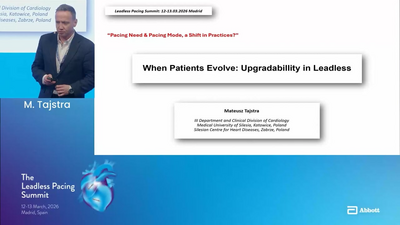
When Patients Evolve: Upgradability in Leadless

Optimizing Tricuspid Valve Crossing: Case example

Optimizing Tricuspid Valve Crossing: Case example

Health Economics of Leadless Therapy

Learn AVEIR Leadless Pacemaker Follow-Up Checks
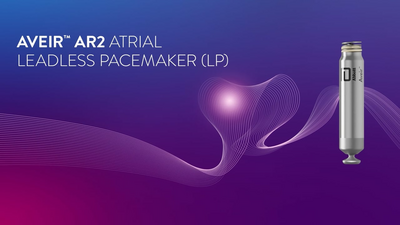
Discover AVEIR AR2: Enhanced Battery Longevity
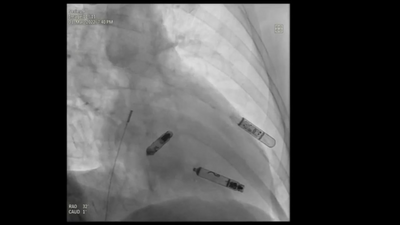
AVEIR DR Implant Positioning Under Fluoroscopy

Introducing AVEIR DR: True AV Synchrony Without Leads
* Dual-chamber model; A,V = 2.5 V @ 0.4 ms; 600 ohms; 100% DDD pacing @ 60 bpm; AutoCapture™ Pacing System OFF; SEGMs ON (10 years). Single-chamber model; A,V = 2.5 V @ 0.4 ms; 600 ohms; 100% VVI pacing @ 60 bpm; AutoCapture™ Pacing System OFF; SEGMs ON (15 years).
† Single-chamber model; dual-chamber model warranty is 8 years; terms and conditions apply; refer to the warranty for details.
‡ No minimum length of time requirement between implant and MRI scan. Stability of pacing capture thresholds is required prior to MRI scan.
§ Particular models and lengths are MR conditional when combined. UltiPace Pacing Leads 46, 52, 58, 65 cm lengths are 1.5T and 3T MR conditional when combined with the Assurity MRI Pacemaker system. Tendril STS Pacing Leads 46, 52, 58 cm lengths are 1.5T and 3T MR conditional when combined with the Assurity MRI Pacemaker system. IsoFlex Optim Pacing Lead 1944 46, 52 cm lengths are 1.5T and 3T MR conditional when combined with the Assurity MRI Pacemaker system. IsoFlex Optim Pacing Lead 1948 52, 58 cm lengths are 1.5T and 3T MR conditional when combined with the Assurity MRI Pacemaker system.
ǁ Terms and conditions apply; refer to the warranty for details.
¶ A,V = 2.5 V @ 0.4 ms; 500 ohms; 100% VVI pacing @ 60 bpm; AutoCapture™ Pacing System OFF; SEGMs ON.
- St. Jude Medical. Data on file. Report 60048640. Market Research Report: Pacemaker Size and Shape. 2012.
- Medtronic. Medtronic Azure™ MRI Surescan™/Astra™ MRI Surescan™ pacing systems MRI technical manual. 2016 Medtronic, M964377A001 B.
- Boston Scientific. Imageready™ MR Conditional Pacing Systems MRI technical guide. Boston Scientific, 360167-003 EN US 2019-07.
- Biotronik. ProMRI System Technical Manual. Biotronik, 5/13/20, MN062r11.
- Lau CP, Sui CW. Pacing technology: Advances in pacing threshold management. J Zhejiang Univ Sci B. 2010;11(8):634-638. doi: 10.1631/jzus.B1001016.
- Abbott. Data on File. Tachy and Bradycardia Devices Help Manual.
- Healey JS, Connolly SJ, Gold MR, et al. Subclinical atrial fibrillation and the risk of stroke. N Engl J Med. 2012;366(2):120-9. doi: 10.1056/NEJMoa1105575. Erratum in: N Engl J Med. 2016;374(10):998. doi: 10.1056/NEJMx160004.
™ Indicates a trademark of the Abbott group of companies.