

RESYNCHRONIZATION
THERAPY DEVICES
Cardiac resynchronization therapy (CRT) is a proven
clinical treatment for heart failure management.
ADVANTAGES OF QUADRIPOLAR TECHNOLOGY IN CARDIAC
RESYNCHRONIZATION THERAPY
Quadripolar technology offers a significant advantage over bipolar technology in CRT, giving you flexibility to access pacing sites and pacing vectors outside the reach of most devices, without compromising lead stability or performance.
Quadripolar technology offers a range of clinical, economic and operational advantages over bipolar technology, including:
REDUCED COSTS

39.8% reduction in heart failure (HF)
hospitalization cost18

54% lower hospitalization rate19

Overall cost savings
(effective resource utilization)20

32.1% reduction of 30-day readmission rate18

Reduction in phrenic nerve stimulation (PNS)21

Reduction in surgical lead revisions22
IMPROVED OUTCOMES

22% relative reduction in
all-cause mortality23

Improved hemodynamics25

Increase in rate of pressure rise (dP/dt)
with biventricular (BiV) pacing at site of
late activation24
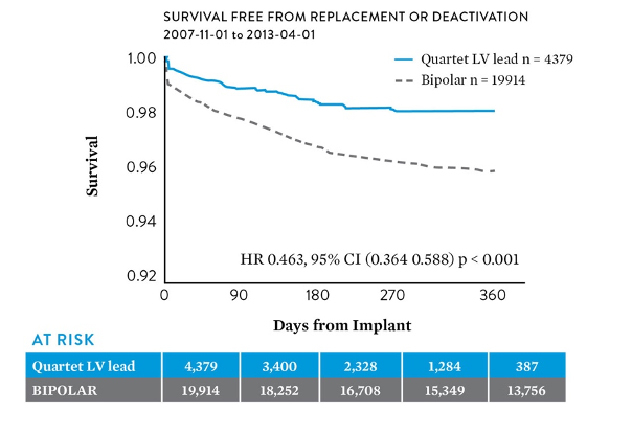
In clinical studies, quadripolar pacing technology has resulted in significantly lower risk of lead deactivation or replacement than bipolar leads.26
LOWER RATES OF DEACTIVATION AND REPLACEMENT
12 MONTHS POST-IMPLANT26
Patients with a quadripolar system may receive more effective CRT than those with bipolar left ventricular (LV) pacing.27
RESULTS
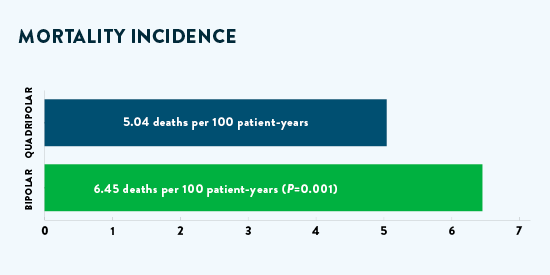
Mortality incidence was significantly lower in the quadripolar group.23
- Quadripolar: 5.04 deaths per 100 patient-years
- Bipolar: 6.45 deaths per 100 patient-years (P=0.001)
After multivariate adjustment, the quadripolar lead was associated with a lower risk of death hazard ratio (HR): 0.77; 95% confidence interval (CI): 0.69 to 0.86; P<0.001.23
CONCLUSIONS
CRT with quadripolar LV system was associated with a 22% relative reduction in mortality compared with a bipolar LV system.23
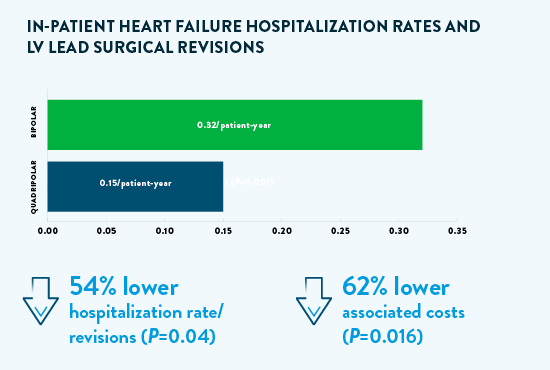
Cost analysis performed on a single-center registry showed the Quartet Quadripolar LV lead was associated with significantly reduced hospitalizations, specific to HF and LV lead surgical revision.19
STUDY RESULTS
- In-patient heart failure hospitalization rates and LV lead surgical revisions were 54% lower for the quadripolar group (0.15/patient-year) than for the bipolar LV group (0.32/patient-year) (P=0.04).19
- The hospitalization rate reduction was accompanied with statistically significant cost savings of 62% (P=0.016).19
MultiPoint™ Pacing (MPP) is associated with clinically relevant and statistically significant reduction of HF hospitalizations and death compared to BiVP.11
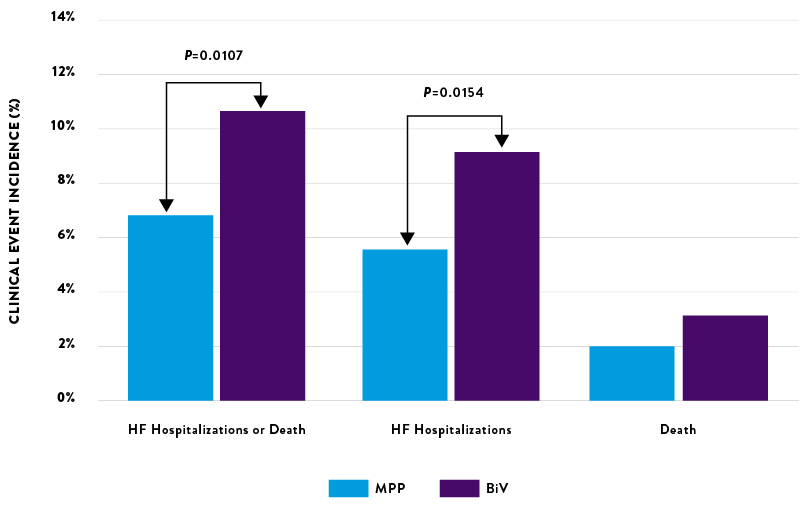

MPP significant clinical benefit vs. BiVP
HF Hospitalization or Death RRR = 36%
HF Hospitalization RRR = 39%
Over time, HF hospitalizations or death was significantly lower in MPP patients compared to BiVP patients.11

MORE-CRT MPP
Watch this video for a summary of the secondary analysis results from the MORE-CRT MPP trial.
Hub
TV

MORE-CRT MPP Video

Video Pfeiffer and markus Stühlinger

Video Pedro Marques + Ana Bernardes

The role of CRT - Carsten Israel

Optimizing CRT: From Conventional to LOT CRT
- Swerdlow CD , Brewer JE, Kass RM, et al. Application of models of defibrillation to human defibrillation data: implications for optimizing implantable defibrillator capacitance. Circulation. 1997;96(9):2813-22. doi: 10.1161/01.cir .96.9.2813.
- Ellenbogen K, Wilkoff G, Kay G, et al. (2007). Clinical Cardiac Pacing, Defibrillation, and Resynchronization Therapy (3rd ed.). Elsevier Saunders; 542-547. ISBN-13: 978-1- 4160-2536-8.
- Kawata U , Birgersdotter-Green U . (2018). Ventricular Fibrillation and Defibrillation, Encyclopedia of Cardiovascular Research and Medicine. Elsevier, 674-682. ISBN 9780128051542. doi: 10.1016/B978-0-12- 809657-4.99764-3.
- Efimov I, Kroll M, Tchou P . (2009). Cardiac Bioelectric Therapy. Springer, 468-472. ISBN 978-0-387-79403-7.
- Kroll M, Lehmann M. (1996). Implantable Cardioverter Defibrillator Therapy. Kluwher Academic Publishers, 68-69.
- Gold MR, Shorofsky SR. Strength-duration relationship for human transvenous defibrillation. Circulation. 1997;96(10):3517-20. doi: 10.1161/01.cir .96.10.3517.
- Kroll MW , Swerdlow CD . Optimizing defibrillation waveforms for ICDs. J Interv Card Electrophysiol. 2007;18(3):247-63. doi: 10.1007/s10840-007-9095-z.
- Doshi SK, Pittaro MD , Reeves R, et al. Efficacy of tuned waveforms based on different membrane time constants on defibrillation thresholds: primary results from the POWER trial. Pacing Clin Electrophysiol. 2012;35(10):1253-61. doi: 10.1111/j. 1540-8159.2012.03500.x.
- Katcher M, Davis K, Badie N, et al. Improved ICD Shock Efficacy using Programmable Pulse Width. Presented at: Heart Rhythm Society; April 24-27, 2025.
- Abbott IFU (Gallant™) (ARTEN600312644 A) , Medtronic IFU (Cobalt‡ ): (M029527C001), Boston Scientific IFU (Resonate‡ , Perciva‡ , Charisma‡ , Viglant‡ , and Momentum‡ ):, Biotronik technical manual (Rivacor‡ ) (439133, Rev. C).
- Leclercq C, Burri H, Calò L, et al. Multipoint pacing is associated with reduction of heart failure hospitalizations or death in patients who do not respond to cardiac resynchronization therapy: results of the MORE-CRT MPP randomized trial. Europace. 2025;27(6):euaf070. doi: 10.1093/europace/euaf070.
- Varma N, O’Donnell D, Bassiouny M, et al. Programming Cardiac Resynchronization Therapy for Electrical Synchrony: Reaching Beyond Left Bundle Branch Block and Left Ventricular Activation Delay. J Am Heart Assoc. 2018;7(3):e007489. doi: 10.1161/JAHA.117.007489.
- Appert L, Menet A, Altes A, et al. Clinical Significance of Electromechanical Dyssynchrony and QRS Narrowing in Patients With Heart Failure Receiving Cardiac Resynchronization Therapy. Can J Cardiol. 2019;35(1):27-34. doi: 10.1016/j.cjca.2018.10.019.
- Okafor O, Leyva F, Zegard A, et al. Changes in QRS Area and QRS Duration After Cardiac Resynchronization Therapy Predict Cardiac Mortality, Heart Failure Hospitalizations, and Ventricular Arrhythmias. J Am Heart Assoc. 2019;8:e013539. doi:10.1161/JAHA.119.013539.
- Varma N, et al. Gain in CRT Efficacy with Dynamic Electrical Optimization: Real World Effect of SyncAV™ CRT on Heart Failure Hospitalizations. Poster presented at European Heart Rhythm Association; May 2020.
- Thibault B, Waddingham P, Badie N, et al. Acute Electrical Synchronization Achieved With Dynamic Atrioventricular Delays During Biventricular and Left Ventricular MultiPoint Pacing. CJC Open. 2024;7(2):166-175. doi: 10.1016/j.cjco.2024.11.003.
- Varma N, Hu Y, Connolly AT, et al. Gain in real-world cardiac resynchronization therapy efficacy with SyncAV dynamic optimization: Heart failure hospitalizations and costs. Heart Rhythm. 2021;18(9):1577-1585. doi:10.1016/j.hrthm.2021.05.006.
- Corbisiero R, Kazemian P, Bharmi R, et al. Less with More: Hospitalization Cost and Event Rates with Quadripolar versus Bipolar CRT-D System. Pacing Clin Electrophysiol. 2016;39(10):1038-1045. doi: 10.1111/pace.12923.
- Forleo GB, Di Biase L, Bharmi R, et al. Hospitalization rates and associated cost analysis of cardiac resynchronization therapy with an implantable defibrillator and quadripolar vs. bipolar left ventricular leads: a comparative effectiveness study. Europace. 2015;17(1):101-7. doi: 10.1093/europace/euu290.
- Graham CM, Gayle J, Magee G. Comparison of healthcare utilization and hospital costs for quadripolar versus bipolar LV lead technologies. Presented at: Heart Rhythm Society; May, 2014; San Francisco, CA.
- Mehta PA, Shetty AK, Squirrel M, et al. Elimination of phrenic nerve stimulation occurring during CRT: follow-up in patients implanted with a novel quadripolar pacing lead. J Interv Card Electrophysiol. 2012;33(1):43-9. doi: 10.1007/s10840-011-9598-5.
- Viani SM, Segreti L, Di Cori A, et al. A new quadripolar lead for left ventricular pacing: Short term reliability and future opportunities. Europace. 2011;13(Suppl.3).
- Turakhia MP, Cao M, Fischer A, et al. Reduced Mortality Associated With Quadripolar Compared to Bipolar Left Ventricular Leads in Cardiac Resynchronization Therapy. JACC Clin Electrophysiol. 2016;2(4):426-433. doi: 10.1016/j.jacep.2016.02.007.
- Pappone C, et al. Left ventricular pacing from a site of late electrical activation improves acute hemodynamic response to cardiac resynchronization therapy. Presented at: Asia Pacific Heart Rhythm Society; Oct, 2012; Taipei, Taiwan.
- Gutleben KJ, Kranig W, Barr C, et al. LV-pacing: Vector optimization using a novel quadripolar electrode acutely improves cardiac output in cardiac resynchronization therapy patients. Europace. 2011:13(3), P403.
- Turakhia MP, Gold MR, Fischer A, et al. Decreased rate of left ventricular lead deactivation and replacement associated with use of quadripolar LV leads. EP Europace. 2013:15(Suppl. 2): S47. doi: 10.1093/europace/eut169.
- Manyam H, Bhimani AA, Sadrpour SA, et al. Quadripolar left ventricular leads yield lower capture thresholds with expected increase in battery longevity. Heart Rhythm. 2013;10(5):S228. doi: 10.1016/j.hrthm.2013.03.019.
™ indicates a trademark of the Abbott group of companies.
‡ Indicates a third-party trademark, which is property of its respective owner.