

RESYNCHRONIZATION
THERAPY DEVICES
Cardiac resynchronization therapy (CRT) is a proven
clinical treatment for heart failure management.
GALLANT™ HF CRT-D SOLUTIONS
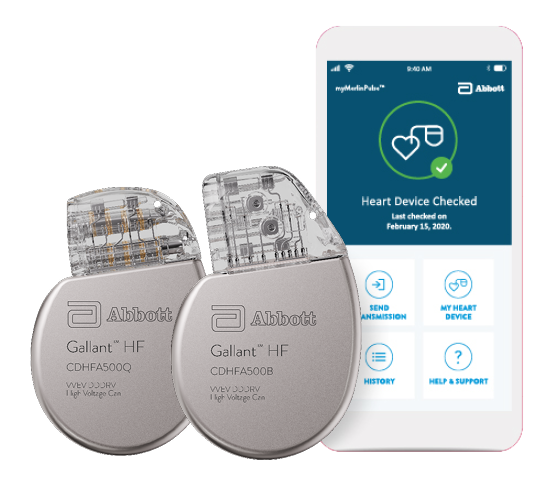
Gallant™ HF cardiac resynchronization therapy defibrillators (CRT-Ds) feature a 40 Joules (J) maximum shock, Bluetooth® connectivity, and improved heart failure (HF) algorithms such as SyncAV Plus™ technology and MultiPoint™ Pacing (MPP). These features achieve fast and effective therapy optimization for your patients.1,2
Timing is everything when shocking a patient out of ventricular fibrillation (VF). Precision Shock Technology (PST) delivers the right energy within the right time for greater first-shock success.3-11 Any energy outside this response window is wasted.
LEARN MORE ABOUT PST:

RIGHT ENERGY + RIGHT TIME
=
GREATER FIRST-SHOCK SUCCESS3
CRT using biventricular pacing (BiVP) is an effective treatment, however, patients who do not respond are at a significantly higher risk of death and heart failure-related hospitalizations compared with CRT responders.
Instead of pacing the left ventricle (LV) from a single site, MultiPoint™ Pacing (MPP) delivers multiple LV pacing pulses per cardiac cycle in both LV only and biventricular (BiV) pacing modes.
The MORE-CRT MPP trial is one of the largest prospective, multicenter, randomized controlled trials designed to assess clinical response in patients indicated to CRT.12
The results from the secondary analysis show that MPP, in patients who do not respond to BiVP, is associated with clinically relevant and statistically significant reduction of hard endpoints, such as heart failure (HF) hospitalizations or all-cause mortality.13
Unlock the MORE-CRT MPP potential with GALLANT™ HF CRT-D
LEARN MORE:
MULTIPOINT™ PACING IN CRT
Understand how advanced visualization of electrical activation can improve outcomes.
Gallant™ HF CRT-D solutions harness smartphone connectivity with long-lasting therapy you can intuitively program to make a powerful difference in your heart failure patients’ lives.
- Achieve fast, effective CRT optimization with SyncAV Plus™ CRT technology
- Encourage greater patient engagement with app-based remote monitoring
- Deliver powerful, lasting therapy with a small, contoured design that is 1.5 Tesla (T) and 3T Magnetic Resonance (MR) Conditional*

1.5T AND 3T MAGNETIC RESONANCE IMAGING (MRI)-READY SOLUTIONS*
GREATER ENGAGEMENT
Gallant™ HF CRT-D solutions offer smartphone connectivity to encourage greater patient engagement.

97% OF PATIENTS WERE COMPLIANT
using Abbott app-based remote monitoring14

ENABLES EARLIER INTERVENTION
by communicating clinically relevant events sooner

PAIRS WITH OUR SECURE myMERLINPULSE™ APP
to streamline communications with your patients, potentially reducing clinic burden and simplifying workflow

MAY SAVE YOU AND YOUR CLINIC TIME
by reducing unnecessary calls to the clinic
PATIENTS CAN USE THE myMERLINPULSE™ APP TO:

CHECK CONNECTIVITY STATUS
to ensure their device is being properly monitored

ACCESS DEVICE STATUS
to check battery status and device model

FIND SUPPORT RESOURCES
such as clinic information, technical support numbers and frequently asked questions (FAQs) site

SEND DATA MANUALLY
as instructed by a clinician

VIEW HISTORY
of scheduled data transmissions, connection issues and patient notifications
SECURED DATA AND INFORMATION
You don’t have to worry about the safety of patient information with Abbott. The myMerlinPulse™ app transmits device status and information to the Merlin.net™ Patient Care Network through a secure, encrypted connection.
Advanced security measures include:
- Encryption when data is at rest and in motion
- Code signed and authenticated in the device, the patient app and the programmer
- Two-way authentication of credentials, for device and user
Hub
TV

MORE-CRT MPP Video

Video Pfeiffer and markus Stühlinger

Video Pedro Marques + Ana Bernardes

The role of CRT - Carsten Israel
Optimizing CRT: From Conventional to LOT CRT
- Thibault B, Waddingham P, Badie N, et al. Acute Electrical Synchronization Achieved With Dynamic Atrioventricular Delays During Biventricular and Left Ventricular MultiPoint Pacing. CJC Open. 2024;7(2):166-175. doi: 10.1016/j.cjco.2024.11.003.
- Calò L, De Ruvo E, Kolb C, et al. Multipoint pacing is associated with improved prognosis and cardiac resynchronization therapy response: MORE-CRT MPP randomized study secondary analyses. Europace. 2024;26(11):euae259. doi: 10.1093/europace/euae259. Erratum in: Europace. 2025;27(2):euaf022. doi: 10.1093/europace/euaf022.
- Katcher M, Davis K, Badie N, et al. Improved ICD Shock Efficacy using Programmable Pulse Width. Presented at: Heart Rhythm Society; April 24-27, 2025.
- Swerdlow CD , Brewer JE, Kass RM, et al. Application of models of defibrillation to human defibrillation data: implications for optimizing implantable defibrillator capacitance. Circulation. 1997;96(9):2813-22. doi: 10.1161/01.cir .96.9.2813.
- Ellenbogen K, Wilkoff G, Kay G, et al. (2007). Clinical Cardiac Pacing, Defibrillation, and Resynchronization Therapy (3rd ed.). Elsevier Saunders; 542-547. ISBN-13: 978-1- 4160-2536-8.
- Kawata U , Birgersdotter-Green U . (2018). Ventricular Fibrillation and Defibrillation, Encyclopedia of Cardiovascular Research and Medicine. Elsevier, 674-682. ISBN 9780128051542. doi: 10.1016/B978-0-12-809657-4.99764-3.
- Efimov I, Kroll M, Tchou P . (2009). Cardiac Bioelectric Therapy. Springer, 468-472. ISBN 978-0-387-79403-7.
- Kroll M, Lehmann M. (1996). Implantable Cardioverter Defibrillator Therapy. Kluwher Academic Publishers, 68 -69.
- Gold MR, Shorofsky SR. Strength-duration relationship for human transvenous defibrillation. Circulation. 1997;96(10):3517-20. doi: 10.1161/01.cir .96.10.3517.
- Kroll MW , Swerdlow CD . Optimizing defibrillation waveforms for ICDs. J Interv Card Electrophysiol. 2007;18(3):247-63. doi: 10.1007/s10840-007-9095-z.
- Doshi SK, Pittaro MD , Reeves R, et al. Efficacy of tuned waveforms based on different membrane time constants on defibrillation thresholds: primary results from the POWER trial. Pacing Clin Electrophysiol. 2012;35(10):1253-61. doi: 10.1111/j. 1540-8159.2012.03500.x.
- Leclercq C, Burri H, Delnoy PP, et al. Cardiac resynchronization therapy non-responder to responder conversion rate in the MORE-CRT MPP trial. Europace. 2023;25(10):euad294. doi: 10.1093/europace/euad294.
- Leclercq C, Burri H, Calò L, et al. Multipoint pacing is associated with reduction of heart failure hospitalizations or death in patients who do not respond to cardiac resynchronization therapy: results of the MORE-CRT MPP randomized trial. Europace. 2025;27(6):euaf070. doi: 10.1093/europace/euaf070.
- Piorkowski C, et al. Early real-world adoption of mobile remote monitoring using the Confirm Rx Insertable Cardiac Monitor. Poster presented at: Asia Pacific Heart Rhythm Society; 2018.
- Device IFUs: Abbott Tachycardia Devices Help Manual (ARTEN600307504A), Medtronic manuals (Evera‡ XT, Amplia‡, Cobalt‡ XT, and Crome‡), Boston Scientific manuals (NG4 Tachy ICD, NG4 Tachy CRT-D), and Biotronik (Rivacor‡ ICDs and CRT-Ds, Acticor‡ ICDs and CRT-Ds).
- Data compiled from clinical study results, on file at St. Jude Medical in Report 60034670.
- Sperzel J, Dänschel W, Gutleben KJ, et al. First prospective, multi-centre clinical experience with a novel left ventricular quadripolar lead. Europace. 2012;14(3):365-72. doi: 10.1093/europace/eur322.
- Duray GZ, Hohnloser SH, Israel CW. Coronary sinus side branches for cardiac resynchronization therapy: prospective evaluation of availability, implant success, and procedural determinants. J Cardiovasc Electrophysiol. 2008;19(5):489-94. doi: 10.1111/j.1540-8167.2007.01096.x.
- Forleo GB, Della Rocca DG, Papavasileiou LP, et al. Left ventricular pacing with a new quadripolar transvenous lead for CRT: early results of a prospective comparison with conventional implant outcomes. Heart Rhythm. 2011;8(1):31-7. doi: 10.1016/j.hrthm.2010.09.076.
- Singh JP, Klein HU, Huang DT, et al. Left ventricular lead position and clinical outcome in the multicenter automatic defibrillator implantation trial-cardiac resynchronization therapy (MADIT-CRT) trial. Circulation. 2011;123(11):1159-66. doi: 10.1161/CIRCULATIONAHA.110.000646.
- Merchant FM, Heist EK, McCarty D, et al. Impact of segmental left ventricle lead position on cardiac resynchronization therapy outcomes. Heart Rhythm. 2010;7(5):639-44. doi: 10.1016/j.hrthm.2010.01.035.
- Jenney C, Tan J, Karicherla A, et al. A new insulation material for cardiac leads with potential for improved performance. Heart Rhythm. 2005;2(5): S318-319. doi:10.1016/j. hrthm.2005.02.1004.