

CARDIOVERTER
DEFIBRILLATORS
Designed to continuously monitor patients’ heart rhythm
and detect irregular heartbeats, implantable cardioverter
defibrillators (ICDs) deliver electrical signals and controlled shocks
in order to restore a normal heart rhythm when necessary.
PRECISION SHOCK TECHNOLOGY
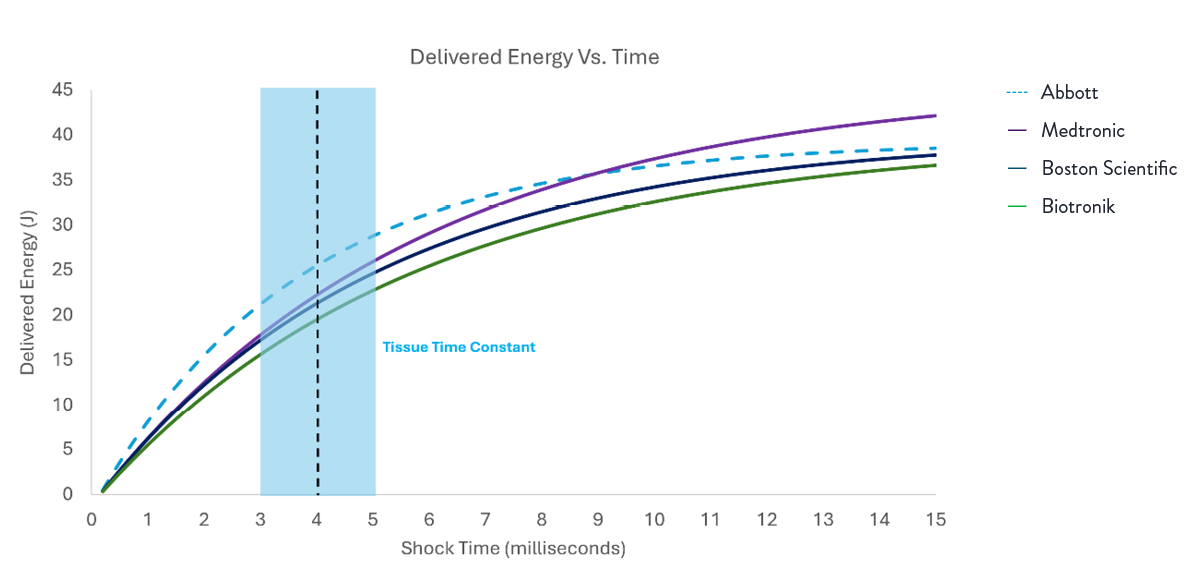
Timing is everything when shocking a patient out of ventricular fibrillation (VF). Precision Shock Technology delivers the right energy within the right time for greater first-shock success.1–9
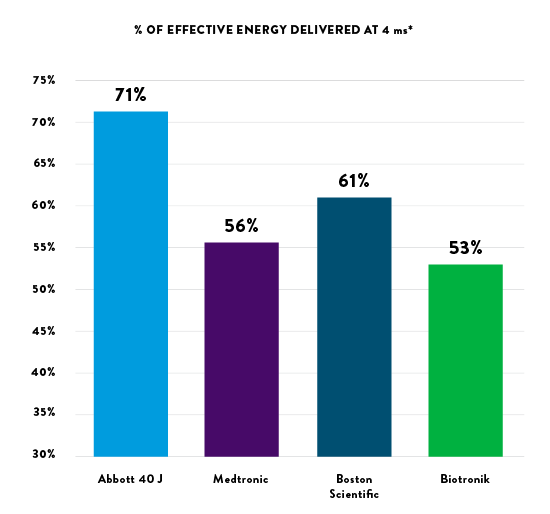
Energy delivered within the tissue time constant of 3–5 ms is the most effective for conversion.1-4 Any energy outside this response window is wasted.
Even at 36 J first shock, Abbott ICDs deliver more energy at the right time.
Hub
TV
MORE-CRT MPP Video
Video Pfeiffer and markus Stühlinger
Video Pedro Marques + Ana Bernardes
The role of CRT - Carsten Israel
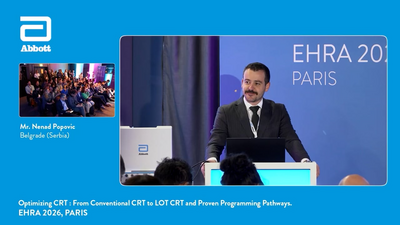
Optimizing CRT: From Conventional to LOT CRT
- Swerdlow CD, Brewer JE, Kass RM, et al. Application of models of defibrillation to human defibrillation data: implications for optimizing implantable defibrillator capacitance. Circulation. 1997;96(9):2813-22. doi: 10.1161/01.cir.96.9.2813.
- Ellenbogen K, Wilkoff G, Kay G, et al. (2007). Clinical Cardiac Pacing, Defibrillation, and Resynchronization Therapy (3rd ed.). Elsevier Saunders; 542-547. ISBN-13: 978-1- 4160-2536-8.
- Kawata U, Birgersdotter-Green U. (2018). Ventricular Fibrillation and Defibrillation, Encyclopedia of Cardiovascular Research and Medicine. Elsevier, 674-682. ISBN 9780128051542. doi: 10.1016/B978-0-12- 809657-4.99764-3.
- Efimov I, Kroll M, Tchou P. (2009). Cardiac Bioelectric Therapy. Springer, 468-472. ISBN 978-0-387-79403-7.
- Kroll M, Lehmann M. (1996). Implantable Cardioverter Defibrillator Therapy. Kluwher Academic Publishers, 68-69.
- Gold MR, Shorofsky SR. Strength-duration relationship for human transvenous defibrillation. Circulation. 1997;96(10):3517-20. doi: 10.1161/01.cir.96.10.3517.
- Kroll MW, Swerdlow CD. Optimizing defibrillation waveforms for ICDs. J Interv Card Electrophysiol. 2007;18(3):247-63. doi: 10.1007/s10840-007-9095-z.
- Doshi SK, Pittaro MD, Reeves R, et al. Efficacy of tuned waveforms based on different membrane time constants on defibrillation thresholds: primary results from the POWER trial. Pacing Clin Electrophysiol. 2012;35(10):1253-61. doi: 10.1111/j.1540-8159.2012.03500.x.
- Katcher M, Davis K, Badie N, et al. Improved ICD Shock Efficacy using Programmable Pulse Width. Presented at: Heart Rhythm Society; April 24-27, 2025.
- Abbott IFU (Gallant™) (ARTEN600312644 A) , Medtronic IFU (Cobalt‡): (M029527C001), Boston Scientific IFU (Resonate‡, Perciva‡, Charisma‡, Viglant‡, and Momentum‡):, Biotronik technical manual (Rivacor‡) (439133, Rev. C).
™ indicates a trademark of the Abbott group of companies.
‡ Indicates a third-party trademark, which is property of its respective owner.