

SETTING THE PACE WITH
AVEIR™ LEADLESS
PACEMAKERS
AVEIR™ LEADLESS
PACEMAKERS
The only leadless solutions that can provide therapy
for all common pacemaker indications1,2,3
ARRIVE: 1-YEAR OUTCOMES
AVEIR™ AR LP VS TRANSVENOUS PACEMAKERS (TVPs) FOR SINUS NODE DYSFUNCTION (SND)12,13
AVEIR™ AR LP patients show significantly lower overall, device-related complications and device reinterventions at 1 year, compared to dual-chamber (DC) TVPs. Also in the unadjusted group with higher comorbidity patients.
| 1 YEAR | |||
|---|---|---|---|
| OVERALL COMPLICATIONS | DEVICE-RELATED COMPLICATIONS | DEVICE REINTERVENTION | ALL CAUSE MORTALITY |
| Adjusted rates AVEIR™ AR LP: 3.6% DC TVP: 8.5% | Adjusted rates AVEIR™ AR LP: 3.5% DC TVP: 7.4% | Adjusted reintervention rates AVEIR™ AR LP: 1.8% DC TVP: 4.5% | Adjusted mortality AVEIR™ AR LP: 9.7% DC TVP: 9.1% |
| 60% lower risk with AVEIR™ AR LP HR 0.4; P< 0.01 | 50% lower risk with AVEIR™ AR LP HR 0.5; P< 0.01 | 60% lower rate with AVEIR™ AR LP HR 0.4 P=0.01 | No statistically significant difference HR 1.1 P=0.73 |
| Kaplan-Meier curves show early separation that persists through 12 months | Key contributors: Fewer infections and inflammatory reactions Lower device dislodgement | Similar rate of 1-year all-cause mortality compared to DC TVP, before and after cohort adjustment. | |
Proven safety in real-world populations
DATA FROM HEART RHYTHM SOCIETY (HRS) 2025
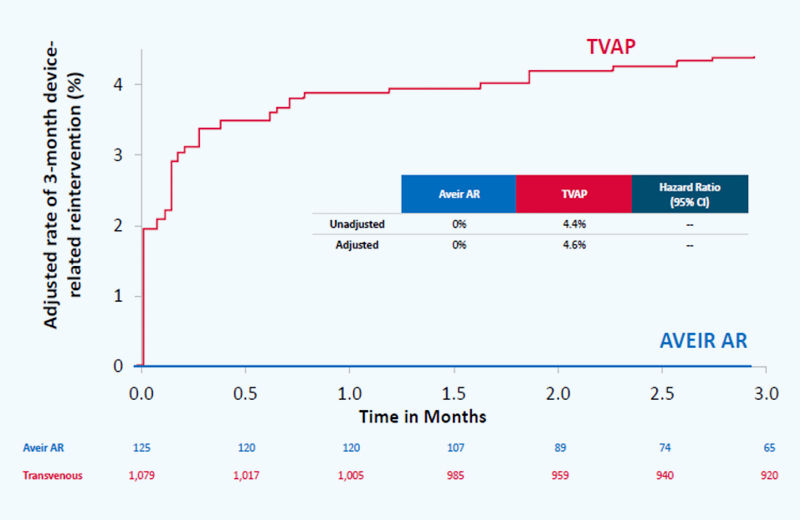
AVEIR™ AR – SIGNIFICANT ADVANTAGES OVER TRANSVENOUS PACEMAKERS (TVPs)14
REAL-WORLD RESULTS FROM COMPARING 125 AVEIR™ AR PATIENTS WITH 1,079 TV PATIENTS
LOWER COMPLICATIONS
- Overall lower rates with AVEIR™ AR before and after adjustment at 3 months (0.9% vs 4.8%, P=0.15)
- Significantly lower rate of device-related complications compared to TVPs at 30 days (0.8% vs 3.3%, P<0.01)
LOWER DEVICE REINTERVENTIONS
- At 3 months, AVEIR™ AR had 0% device reintervention rate compared to 4.6% among TVPs
COMPARABLE MORTALITY
- At 3 months, AVEIR™ AR had significantly lower mortality rates than TVPs after adjustment (2.7% vs 5.3%, P=0.03)
Connext
TV
TV
TV
Understanding AVEIR VR Retrieval

Why Leadless Pacing Summit 2026 Matters
AVEIR Atrial LP AAI Implant Training Supplement
AVEIR DR Virtual Implant Training Supplement
Leadless in Congenital Patients
When Patients Evolve: Upgradability in Leadless

Optimizing Tricuspid Valve Crossing: Case example
Optimizing Tricuspid Valve Crossing: Case example

Health Economics of Leadless Therapy

Learn AVEIR Leadless Pacemaker Follow-Up Checks
References
- AVEIR™ Leadless Pacemakers and Delivery Catheter IFU. ARTEN600361108.
- Micra‡ VR2 MC2VR01 IFU.
- Micra‡ AV2 MC2AVR1 IFU.
- Lo M, Amin A, Kowalski M, et al. Are Dual Leadless Pacemakers Safer than Transvenous Devices? Real-World Evidence from AVEIR™ DR Coverage with Evidence Development Study. Abstract presented at: Asia Pacific Heart Rhythm Society; Nov 12-15, 2025; Yokohama, Japan. [Data obtained from final presentation].
- Knops RE, Reddy VY, Ip JE, et al. A Dual-Chamber Leadless Pacemaker. N Engl J Med. 2023;388(25):2360-2370. doi: 10.1056/NEJMoa2300080.
- Knops RE, Reddy VY, Ip JE, et al. Safety and Electrical performance of the first dual-chamber leadless pacemaker at 6 months post-implant. Presented at: Asia Pacific Heart Rhythm Society; Sep 1-3, 2023; Hong Kong.
- Udo EO, Zuithoff NP, van Hemel NM, et al. Incidence and predictors of short- and long-term complications in pacemaker therapy: the FOLLOWPACE study. Heart Rhythm. 2012;9(5):728-35. doi: 10.1016/j.hrthm.2011.12.014.
- Reddy, VY, et al. Worldwide Experience with Leadless Pacemaker Retrievals: A Worldwide Nanostim Experience out of 9y. Presented at: Asia Pacific Heart Rhythm Society; Nov 18-20, 2022; Singapore.
- Gimbel JR, Bello D, Schmitt M, et al. Randomized trial of pacemaker and lead system for safe scanning at 1.5 Tesla. Heart Rhythm. 2013;10(5):685-91. doi: 10.1016/j. hrthm.2013.01.022.
- Ip JE, Badie N, Rashtian M, et al. Novel Pacing Mode Conserves Battery in Dual-Chamber Leadless Pacemakers. J Cardiovasc Electrophysiol. 2026;37(2):338-346. doi: 10.1111/jce.70224.
- Garweg C, Defaye P, Neuzil P, et al. Long term outcomes of dual chamber leadless pacemaker insights from European patients data. Poster presented at: European Heart Rhythm Association; April 12-14, 2026; Paris.
- Nilsson KR Jr, Birgersdotter-Green U, Saleem-Talib S, et al. Leadless atrial versus transvenous pacing for sinus node dysfunction: 1-year outcomes from the leadless ARRIVE real-world study. Europace. 2026;28(4):euag072. doi: 10.1093/europace/euag072.
- Glikson M, Nielsen JC, Kronborg MB, et al. 2021 ESC Guidelines on cardiac pacing and cardiac resynchronization therapy. Eur Heart J. 2021;42(35):3427-3520. doi: 10.1093/eurheartj/ehab364. Erratum in: Eur Heart J. 2022 May 1;43(17):1651. doi: 10.1093/eurheartj/ehac075.
- Nilsson KR, Birgersdotter-Green UM, Diaz JO, et al. PO-06-004 Leadless vs. transvenous atrial pacemakers: Real-world evidence from AVEIR™ AR coverage with evidence development study. Heart Rhythm. 2025;22(4):S633. Doi:10.1016/j.hrthm.2025.03.1552.
- I p JE, Brady PA, Kroman AM, et al. Leadless Versus Transvenous Single-Chamber Ventricular Pacemakers: Real-World Evidence From AVEIR™ VR Coverage With Evidence Development Study. J Am Heart Assoc. 2025;14(21):e042471. doi: 10.1161/JAHA.125.042471.
- Reddy VY, Exner DV, Doshi R, et al. Primary Results on Safety and Efficacy From the LEADLESS II-Phase 2 Worldwide Clinical Trial. JACC Clin Electrophysiol. 2022;8(1):115-117. doi: 10.1016/j.jacep.2021.11.002.
- Reddy VY, et al. Chronic Performance of a Novel Leadless Pacemaker: 1 Year Results from the LEADLESS II Trial. Presented at: Asia Pacific Heart Rhythm Society; Nov 18-20, 2022; Singapore.