

CARDIAC MONITORDESIGNED TO OUTPERFORM,
BUILT TO OUTLAST
ADVANCED AI ALGORITHMS: POST-MARKET STUDY
A post-market study of Assert-IQ™ insertable cardiac monitor (ICM) in 151 real-world patients is the first clinical study to evaluate ICM atrial fibrillation (AF) detection and artificial intelligence (AI) performance in direct comparison with the established gold standard, Holter monitoring.1
OVERALL PERFORMANCE OF ASSERT-IQ™ ICMs WITH AI

Patient Sensitivity
Assert-IQ™ ICMs with AI demonstrate 100% sensitivity for AF with no delay in diagnosis1

Episode-based PPV
Assert-IQ™ ICMs with AI achieves 93.6% episode-based positive predictive value (PPV) while maintaining high sensitivity1

Episode-Based Sensitivity
Proves 99.4% sensitivity in detecting AF episodes vs Holter, with AI retaining all true episodes1

Duration Sensitivity
Assert-IQ™ ICMs with AI deliver 93.0% duration sensitivity1
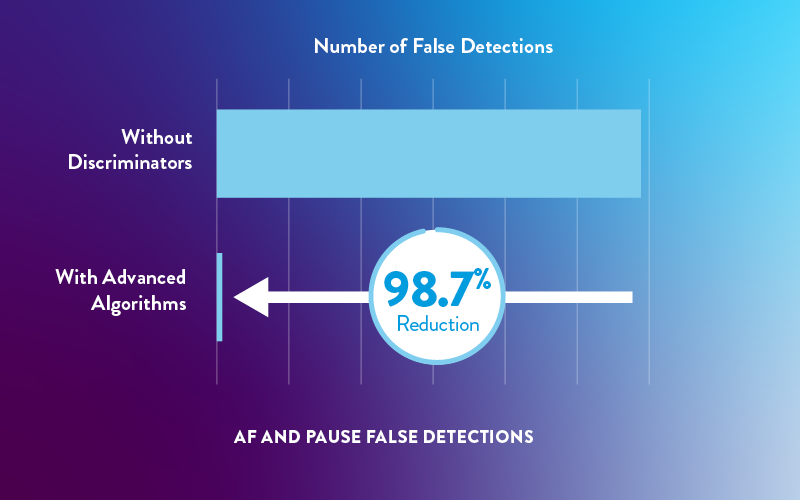
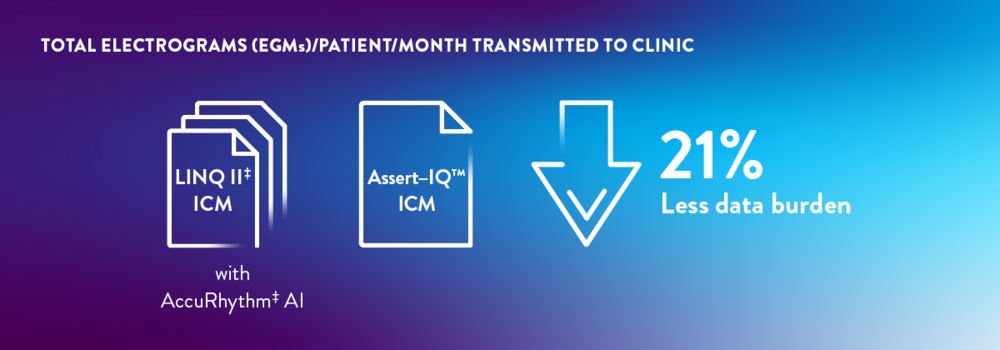
FASTER AF DIAGNOSIS FOUND WITH REAL-WORLD EVIDENCE
A nationwide study of US Medicare beneficiaries with stroke who received an ICM or an external cardiac monitor (ECM) after ischemic stroke demonstrates ICMs provide effective AF detection, with almost three times more AF detected compared to ECMs.6
New AF Diagnosis in ICM vs ECM Patients
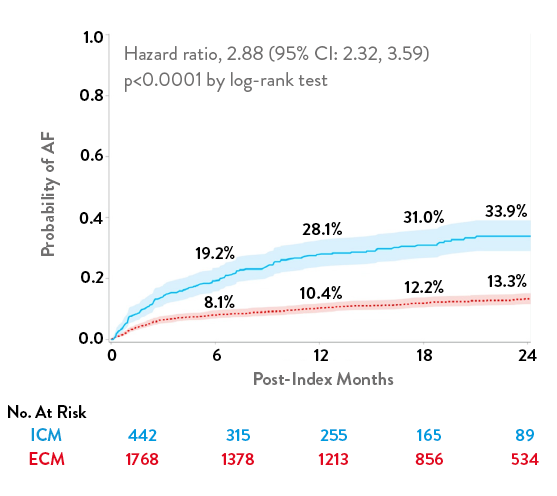
ICMs DETECT MORE AF THAN CONVENTIONAL METHODS
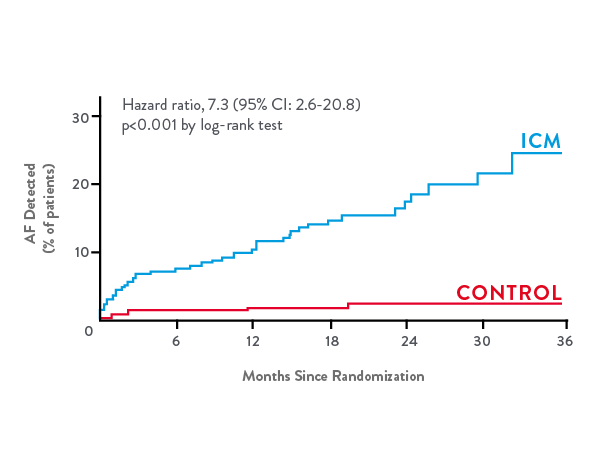
Cryptogenic stroke and underlying atrial fibrilitation studs (CRYSTAL AF).7
The CRYSTAL AF study evaluated the incidence of paroxysmal AF in patients with cryptogenic stroke and transient ischemic attack (TIA) using an ICM.
Detection of AF by 36 Months
FIND OUT MORE:
MEAN TOTAL SEVERE CARDIOVASCULAR EVENTS* 26% HIGHER IN NON-ICM VS ICM PATIENTS POST-AF ABLATION8**
Real-world example: Clinical outcomes after ablation of AF in patients with and without ICM.
| AF-RELATED EVENTS | MEAN NUMBER OF EVENTS | |
|---|---|---|
| ICM | NON-ICM | |
| AF HOSPITALIZATION | 0.69 | 0.81 |
| HF HOSPITALIZATION | 0.22 | 0.33 |
| TOTAL SEVERE CARDIOVASCULAR EVENTS* | 1.09 | 1.37 |
Hub
TV

Remote Programming Overview
What’s New in ICM: Beyond Diagnosis

AV Block Programming Webinar
ICM Indications Update
- Birgersdotter-Green U, Ojeda W, Manyam H, et al. Atrial fibrillation detection performance of an insertable cardiac monitor: Results from an Assert-IQ™ post-market clinical study and a novel artificial intelligence algorithm. Heart Rhythm O2. 2025;7(1):61-69. doi: 10.1016/j.hroo.2025.10.021.
- Gopinathannair R, Shehata MM, Afzal MR, et al. Novel algorithms improve arrhythmia detection accuracy in insertable cardiac monitors. J Cardiovasc Electrophysiol. 2023;34(9):1961-1968. doi: 10.1111/jce.16007.
- Data on File. Abbott - Report SJM-CFM-0919-0163.
- Radtke AP, Ousdigian KT, Haddad TD, et al. Artificial Intelligence Enables Dramatic Reduction of False Atrial Fibrillation Alerts from Insertable Cardiac Monitors. Abstract B-AB24-04 presented at Heart Rhythm Society; August 2021; Boston, USA.
- Data on File. Abbott - Report 90986479A; AF EGM Burden Reduction in Assert-IQ™ ICM.
- Boriani G, Auricchio A, Botto GL, et al. Insertable cardiac monitoring results in higher rates of atrial fibrillation diagnosis and oral anticoagulation prescription after ischaemic stroke. Europace. 2023;25(9):euad212. doi: 10.1093/europace/euad212.
- Sanna T, Diener HC, Passman RS, et al. Cryptogenic stroke and underlying atrial fibrillation. N Engl J Med. 2014;370(26):2478-86. doi: 10.1056/NEJMoa1313600.
- Mansour MC, Gillen EM, Garman A, et al. Healthcare Utilization and Outcomes in Atrial Fibrillation Ablation Patients With and Without Insertable Cardiac Monitoring. European Heart Journal. 2020;41:545. doi:10.1093/ehjci/ehaa946.0545.
™ indicates a trademark of the Abbott group of companies.