

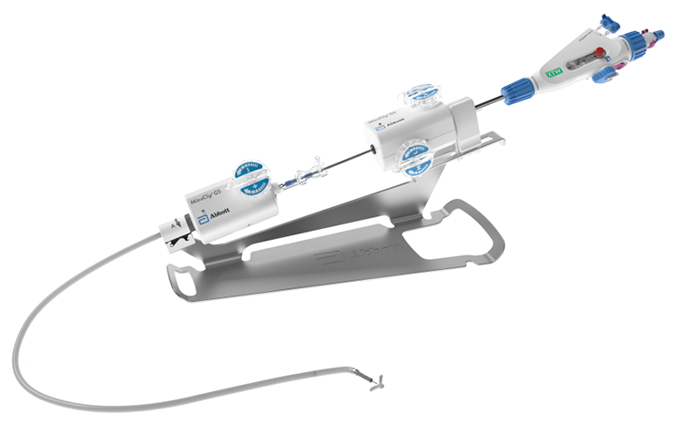
MitraClip™ ist die erste minimalinvasive Therapie zur Transkatheter-
Mitralklappenrekonstruktion mittelsEdge-to-Edge-Reparatur (TEER*).
Sie bietet ausgewählten Patient:innen mit primärer Mitralinsuffizienz (PMR)
oder sekundärer Mitralinsuffizienz (SMR), die andernfalls möglicherweise
unbehandelt blieben, eine wirksame Behandlungsoption.1,2
MitraClip™ gilt als etablierter Standard in der Transkatheter-
Mitralklappenreparatur (TMVr) und basiert auf mehr als 20 Jahren
Erfahrung in der Mitralklappentherapie, einer umfassenden klinischen
Evidenz sowie weltweit über 200.000 behandelten Patient:innen.3



WEGBEREITER FÜR DIE WEITERENTWICKLUNG MODERNER
LEITLINIEN ZUR MITRALINSUFFIZIENZ
MitraClip™ ist die erste TMVr (TEER)-Therapie, die von den Richtlinien des American College of Cardiology/American Heart Association (ACC/AHA), der European Society of Cardiology/European Association for Cardio-Thoracic Surgery (ESC/EACTS) und der Asian Pacific Society of Cardiology (APSC) Konsensempfehlungen für ausgewählte PMI- und SMI†-Patienten empfohlen haben. Die Leitlinien fordern eine intensive Überwachung und frühzeitige Maßnahmen mit dem Ziel, Komplikationen aufgrund einer linksventrikulären (LV) Volumenüberlastung zu verhindern.4,10-12
LEITLINIEN
INFORMATIONEN FÜR PATIENT:INNEN:

Chirurgischer Eingriff wird oft nicht angeboten oder abgelehnt
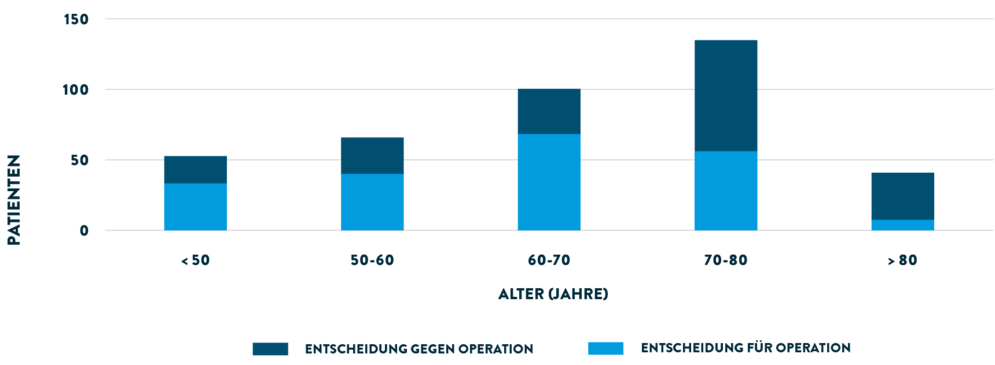
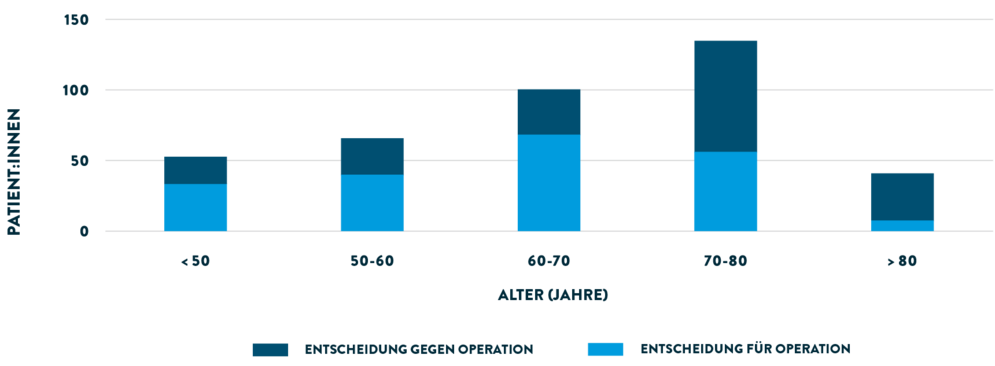
49 % der Patient:innen mit symptomatischer hochgradiger Mitralinsuffizienz (MI) werden aufgrund von Alter, Komorbiditäten oder einer eingeschränkten linksventrikulären Funktion nicht operiert.5Ohne Behandlung geht die MI mit einer ungünstigen Prognose einher. Die 1‑Jahres-Mortalität kann bis zu 57 % betragen.6

SELEKTION DER PATIENT:INNEN FÜR DIE
MITRACLIP™-THERAPIE
MITRACLIP™ PROZEDURALES IMAGING
LEITFADEN ZUR POSITIONIERUNG UND BILDGEBUNGHIER HERUNTERLADEN
MITRACLIP™ TEE-SCREENING
LEITFADEN ZUR TRANSTHORAKALEN ECHOKARDIOGRAFIEHIER HERUNTERLADEN
MITRACLIP™ TTE-SCREENING
LEITFADEN ZUR TRANSTHORAKALEN ECHOKARDIOGRAFIEHIER HERUNTERLADEN
TV

ESC 2026 | Live echocardiography
ESC 2026 Symposium
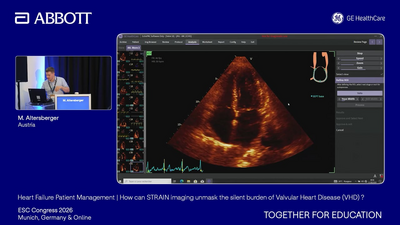
ESC 2026 | Heart Failure Patient Management

ESC 2026 | Live echocardiography

ESC 2026 | Procedural hands-on | Mitral Regurgitation

ESC 2026 | Procedural hands-on | Mitral Regurgitation

A Defining Moment Has To Start Somewhere. Why Not With You?

Webinar for Collaborative Management of HF Patients with MR

M-TEER: Best treatment strategies for FMR AND DMR

M-TEER: State of the art echocardiography imaging modalities
**Dieser Erfahrungsbericht beschreibt die Reaktion einer Person auf die Behandlung. Der Bericht dieser Patientin ist echt, typisch und dokumentiert. Er stellt jedoch keinen Hinweis, Leitfaden, Gewährleistung oder Garantie hinsichtlich der Reaktion anderer Personen auf die Behandlung dar. Die Reaktionen auf die besprochene Behandlung können variieren und sind spezifisch für den einzelnen Patienten.
**Tests durchgeführt und Daten hinterlegt von Abbott
- MitraClip™ G4 System Instructions for Use.
- Lim DS, Reynolds MR, Feldman T, et al. Improved functional status and quality of life in prohibitive surgical risk patients with degenerative mitral regurgitation after the transcatheter mitral valve repair. J Am Coll Cardiol. 2014;64(2):182–192. doi.org/10.1016/j.jacc.2013.10.021.
- Data on file at Abbott.
- Heidenreich PA, Bozkurt B, Allen LA, et al. “2022 AHA/ACC/HFSA Guideline for the Management of Heart Failure: A Report of the American College of Cardiology/American Heart Association. Joint Committee on Clinical Practice Guidelines.” J Am Coll Cardiol. 2022;28(5):E1–E167. doi.org/10.1016/j.cardfail.2022.02.010.
- Mirabel M, Lung B, Baron G, et al. What are the characteristics of patients with severe, symptomatic, mitral regurgitation who are denied surgery? Eur Heart J. 2007;28(11):1358–1365. doi.org/10.1093/eurheartj/ehm001.
- Cioffi G, Tarantini L, De Feo S, et al. Functional mitral regurgitation predicts 1-year mortality in elderly patients with systolic chronic heart failure. Eur J Heart Fail. 2005;7(7):1112–1117. doi.org/10.1016/j.ejheart.2005.01.016.
- Rottbauer WD. Contemporary Clinical Outcomes with MitraClip™ (NTR/XTR) System: Core-lab Echo Results from +1000 Patient the Global EXPAND Study. Data presented at PCR 2020.
- Maisano F. Clip Selection Strategy and Outcomes with MitraClip™ (NTR/XTR): Evidence-Based Recommendations from the Global EXPAND Study. Data presented at PCR 2020.
- Rodriguez E. Contemporary Outcomes with the MitraClip™ G4 System: Preliminary Results based on the EXPAND G4 Study. Data presented at TCT 2021.
- Vahanian A, Beyersdorf F, Praz F, et al. ESC/EACTS Scientific Document Group, 2021 ESC/EACTS Guidelines for the management of valvular heart disease: Developed by the Task Force for the management of valvular heart disease of the European Society of Cardiology (ESC) and the European Association for Cardio-Thoracic Surgery (EACTS), Eur Heart J.2022;43(7):561–632, doi.org/10.1093/eurheartj/ehab395.
- Yeo KK, Tan JWC, Muller DW, et al. Asian Pacific Society of Cardiology Consensus Recommendations on the Use of MitraClip for Mitral Regurgitation. Eur Cardiol. 2021;16:e25. doi.org/10.15420/ecr.2021.01.
- McDonagh TA, Metra M, Adamo M, et al., ESC Scientific Document Group, 2021 ESC Guidelines for the diagnosis and treatment of acute and chronic heart failure: Developed by the Task Force for the diagnosis and treatment of acute and chronic heart failure of the European Society of Cardiology (ESC) With the special contribution of the Heart Failure Association (HFA) of the ESC, Eur Heart J.2012; 42(36):3599–3726, doi.org/10.1093/eurheartj/ehab368.
- Stone G, et al. Five-Year Follow-up after Transcatheter Repair of Secondary Mitral Regurgitation, N Engl J Med 2023; 388;2037-2048. Feldman T. et al. Randomized Comparison of Percutaneous Repair and Surgery for Mitral Regurgitation: 5-Year Results of EVEREST II. JACC. December 2015; 66(25):2844-2854. Nickenig G. et al. Percutaneous edge-to-edge repair for tricuspid regurgitation: 3-year outcomes from the TRILUMINATE trial. JACC. 2024 September 23; 17(18):2113-2122
- Maisano F. Clip Selection Strategy with 4th Generation MitraClip™: Evidence-Based Recommendations from the Global EXPAND Study. Data presented at PCR London Valves 2022.